
The Somatic Gifts of Gratefulness
How a grateful state reorganizes the body: cell, nerve, and frequency
We tend to speak of gratefulness as a feeling. It is that — and it is also an event in the body. The moment you enter a grateful state, you are not simply thinking a kinder thought; you are shifting the frequency your whole system organizes around. Your nervous system, your heart, your hormones, and your cells all read that frequency and begin to move with it. What follows is the body coming into coherence — trading the static of fear for a cleaner signal.
Here is what is happening inside you, braided together: the physiology science can measure, and the energetic reading underneath it.
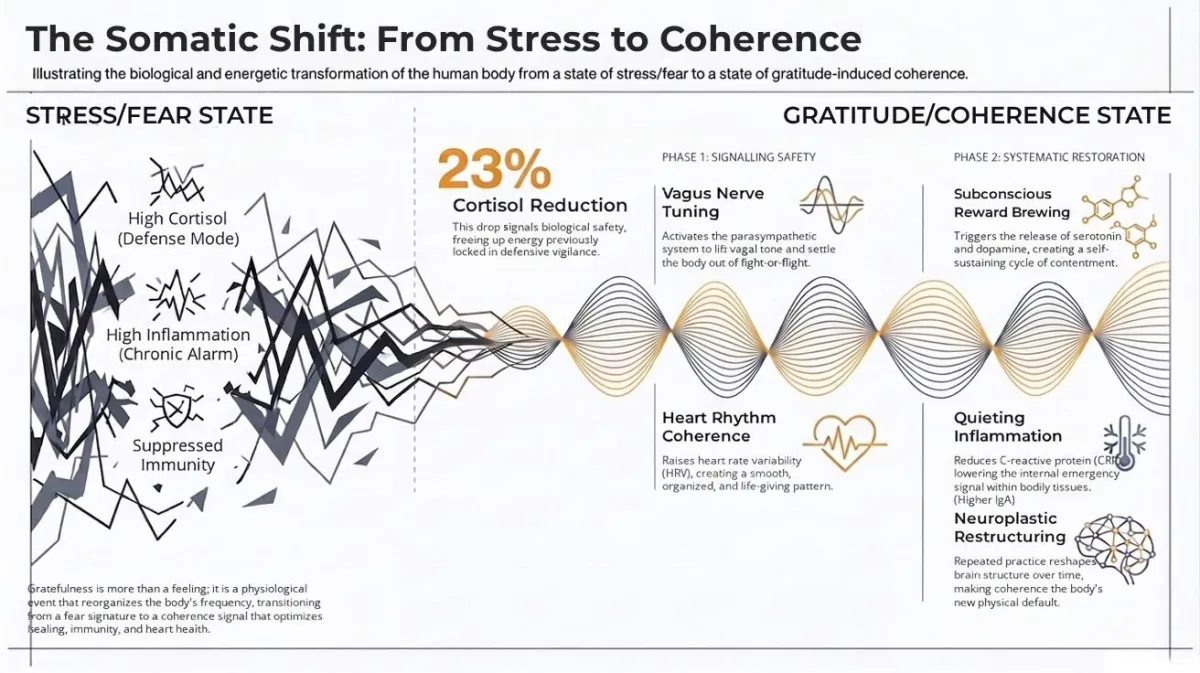
Your vagus nerve begins to tune: Physiologically, gratefulness activates the parasympathetic nervous system through the vagus nerve, lifting what researchers call vagal tone — the body's capacity to settle out of fight-or-flight and back into rest, repair, and digestion. Energetically, the vagus nerve is your inner tuning fork. A grateful frequency strikes it, and the whole instrument of the body stops bracing and starts receiving.
Cortisol comes down, and safety comes online: Consistent gratitude practice has been shown to lower cortisol — the primary stress hormone — by as much as 23%. When cortisol falls, the body stops spending its resources on defense. In frequency terms, high cortisol is the body's fear signature; as it releases, your system finally gets the message it has been waiting for — you are safe — and the energy once locked in vigilance is freed to create, heal, and expand.
The heart finds its rhythm: Gratefulness raises heart rate variability (HRV), a marker of a flexible, resilient heart, and is associated with healthier blood pressure and lower risk of adverse cardiac events. HRV is, quite literally, the heart's coherence — the smooth, ordered rhythm of a heart no longer at war with itself. A grateful heart doesn't just feel more open; it beats in a more organized, life-giving pattern.
Your body brews its own reward: Gratefulness lights up the limbic system and the hypothalamus, prompting the release of serotonin and dopamine — the neurochemistry of contentment and motivation. You are not borrowing joy from outside yourself; you are generating it from within. This is frequency as self-sustaining source: the grateful state produces the very chemistry that makes it easier to return to gratefulness again tomorrow. Coherence begets coherence.
Inflammation quiets: Regular gratitude practice is linked to reduced inflammatory markers, including C-reactive protein (CRP). Inflammation is the body's chronic alarm — a low, constant hum of internal emergency. As gratefulness lowers that signal, the body stops flaring against itself. Energetically, this is the frequency of peace reaching all the way down into the tissue.
Sleep deepens and immunity strengthens: Through the hypothalamus — the brain's regulator of sleep — gratefulness promotes deeper, more restorative rest, while lowering cortisol and supporting immune markers like IgA that help the body fend off illness. Rest is where the body does its most sacred repair. A grateful nervous system stops standing guard through the night and lets the deeper, restorative frequencies do their work.
Over time, the brain itself reshapes: People with higher trait gratefulness show measurable differences in brain structure and report fewer everyday complaints — headaches, congestion, digestive upset, poor sleep. This is neuroplasticity: a practiced frequency becoming physical form. What you tune to repeatedly, you become. Gratefulness, practiced, doesn't just pass through you — it builds you.
The whole picture
Notice the pattern. Gratefulness pulls the body out of the frequency of fear — high cortisol, inflammation, a guarded and rigid nervous system — and into the frequency of coherence: vagal tone, heart-rhythm order, restorative sleep, self-generated joy. This is not metaphor laid over biology. It is one event described in two languages. The body is an antenna, and gratefulness is one of the cleanest signals we can offer it.
This is why a daily gratitude practice is so much more than a nice habit. Each time you choose it, you are optimizing the very functions that keep you alive and well — and you are doing it from the inside, by frequency, the way you were designed to.
You are not adding gratefulness to your life. You are returning your body to the frequency it already knows as home.
Sources on the physiology of gratitude: Positive Psychology, American Brain Foundation, Nuvance Health, The Good Trade, and peer-reviewed studies on gratitude, heart rate variability, and cortisol.

Candace Stuart-Findlay
Volunteer since 2021
Start Sharing Your Gratitude!
Join us on Clubhouse
Follow Us


